The Lost Spiritual Traditions of the Filipino Martial Arts: Orasyon and Anting-Anting
5/6/2026 (originally written 10/19/25)

The Filipino Martial Arts (known as Arnis, Kali, or Eskrima) have seen extensive international recognition since the 1960’s, when instruction began to expand beyond the Philippines. Schools featuring the many traditional and newly developed styles now operate all over the world, taught by Filipino and non-Filipino masters alike. This cultural boom has created an opportunity to not only preserve the arts, but to make a living doing so. But in this global spread something seems to have been lost to the modern arnisador (one who practices Arnis), that being the spiritual edge that was once so prevalent in the old culture; the folk magics of orasyon and anting-anting.
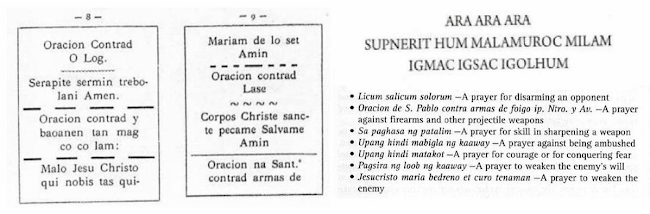
Orasyon (oh-rah-shón), derived from the Spanish word for prayer ‘oración’, are prayer-spells intended to invoke the power of God. They’re derived from a syncretic combination of indigenous animism and Spanish Catholicism, and typically constructed from an amalgam of Latin, Spanish, Filipino, and Latin-esque gibberish. Believers design such spells for any manner of things; ranging from everyday good fortune to as extreme as making one’s skin impervious to harm. Orasyon can be utilized in verbal or mental recitation, as well as in writing them on paper or other objects to imbue them with power.

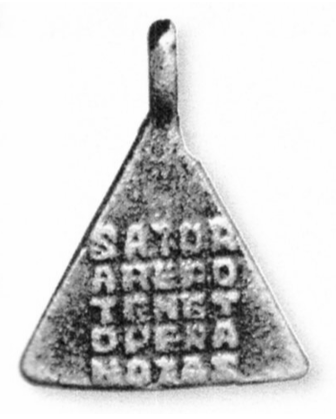
Anting-anting are objects of power, typically in the form of a small charm. These charms could be things found in nature - small smooth stones, the teeth or bones of an animal, a dried root of a rare plant, a seed from an old tree - or be crafted in a diverse range of mediums. Crafted anting-anting are much more common, typically taking the form of wood or metal amulets inscribed with orasyon and/or spiritual symbols. Those who collect orasyon and symbols might record them in a pocket-sized book known as a librito, such books are considered very powerful anting-anting due to the concentrated potency they’re believed to contain.

Strong believers would opt to have orasyon or anting-anting tattooed to have a permanent effect, or so that they could not be lost or stolen away by others seeking the user’s power. Others might embed a small anting-anting under the skin, or swallow them to absorb their power. As they relate to the arnisadores of the past, such magics were utilized in effort to give them an edge over their opponents or attackers, as well as to aid in survival and healing. Many would carry anting-anting or wear orasyon tattoos for protection or to enhance their martial abilities. The general result being they might feel more confident they had the power of God to supplement their combative skills.

Historical accounts within the Filipino martial arts community reflect these beliefs. In the documentary Eskrimadors (2010) a story is told of Grandmaster Vicente Carin of the Doce Pares style (1921-2003) who carried anting-anting throughout his life. There were a handful of instances in his life where he would attribute his survival to anting-anting, most notably were the occasions where guns had jammed or missed when fired at him. The famed duelist Antonio “Tatang” Ilustrisimo, Grandmaster of the Kalis Ilustrisimo style (1904-1997), was a full believer in orasyon and anting-anting. So much so that he had an orasyon tattooed across his chest. In an interview detailed in Mark V. Wiley’s book “Filipino Martial Culture”, Ilustrisimo goes on to say:
“I am Catholic now but I was also brought up Muslim - I believe in orasyon and pray every day at three o'clock and six o'clock, without fail. I also have anting-anting. You cannot abuse this power or God will punish you. When I fight, I repeat the orasyon over and over in my mind during the fight and the enemy takes a loss. Sometimes I have dreams of fighting and [how] I will be protected.”
Antonio’s uncle and teacher, Grandmaster Regino Ilustrisimo of the Repeticion style (1894-1981), was known to have tattoos covering his arms and legs. As of writing it is unknown if the designs on his arms were orasyon, but it is certain that the tattoo on his calf was. He’d gotten this protective tattoo from his brothers once Regino had attained a certain level of proficiency in the art under their tutelage. According to IMB Academy’s Chief Instructor, Richard Bustillo, Antonio Ilustrisimo also had such a calf tattoo and would carry on this tradition of tattooing high level students. Bustillo, who trained under Antonio, received such an orasyon himself.

What is interesting about the orasyon of Regino Ilustrisimo is that his brothers were part of the forces who’d fought against the Spaniards in the Philippine Revolution. Many styles of arnis were developed at this time, but it was also a time when the use of orasyon and anting-anting would become very popular among soldiers and generals alike. Andres Bonafacio, Leader of The Katipunan (the Filipino revolutionaries), was not only known to carry anting-anting, but he distributed anting-anting among his soldiers to keep them safe; pieces of cloth said to have been worn by holy Filipino martyrs. One of the last generals of The Katipunan, Macario Sakay, had constructed a vest inscribed with several orasyon and protective diagrams that he’d wear under his uniform; many such vests from this era have been documented. The popularity of protective orasyon and anting-anting amongst Filipino revolutionaries suggest their prevalence amongst the old arnisadores likely reflect a direct cultural inheritance.
Why is it then that such a tradition has largely been lost to the modern Filipino martial arts practitioner? It can be surmised that the arnisadores of old lived in much more violent times. Not just because they had to face foreign adversaries from Spain, The United States, and Japan, but it was also an era in which mortal duels of honor and reputation among martial artists were fairly common. It should be stated that no arnisador worth their title would claim to rely on orasyon or anting-anting over skill, but in such a time where a long life was uncertain, one could only hope that training and experience would be enough to survive, and it surely must have served some comfort to believe that one can attain a degree of divine protection on top of it all. Believers of orasyon and anting-anting still exist today though primarily in the realm of folk healers and spirit mediums, no longer largely associated with arnisadores and the culture of combat.
This is not necessarily a vital loss to the modern community. The Filipino martial arts have always sought to be practical, taking global influences and ever evolving in pursuit of this goal. But though the arts may be strong, they now largely lack that uniquely Filipino variety of spiritual dimension. It’s almost as if the old traditions of masters personally passing down a spell or charm to students have been replaced with the exchanging of certificates and multi-colored belts. Such is the course when an art is commercialized and brought to the rest of the world. Not all aspects can be sold and surely most students looking for martial arts are not also looking to participate in what can be seen as unnecessary magic rituals. But though it may not be necessary, it would certainly be fun to see a degree of mystic mystery and whimsy revitalized in an increasingly secular art.
How magical it used to be, to be an arnisador.